
 India
India



Tara Paints Pvt. Ltd., known through its TARALAC brand since 1977, works with buyers and technical teams that need coatings to perform consistently across wood, metal, automotive interiors, consumer goods, and other industrial substrates. With more than 15,000 dealers, over 700 industrial users, and manufacturing facilities built for high-volume production, our company has earned a practical reputation as a dependable NC paint manufacturer for businesses across India.
Organisations evaluating an NC paint manufacturer in India rely on consistent formulation standards, technical clarity, and assured batch stability, all of which anchor TARALAC’s production approach.
Over the past four decades, Tara Paints has expanded infrastructure, R&D capacity, and automated systems to support large-scale NC paint systems tailored for modern manufacturing lines. The company’s facilities in Ahmedabad and Changodar have evolved into high-capacity hubs for the formulation of nitrocellulose-based coatings, primers, sealers, and specialty industrial finishes.
This track record makes TARALAC a suitable choice for businesses that compare Top NC paint manufacturers before finalising procurement.
What Are NC Paints?
NC paints, or nitrocellulose paints, are fast-drying coatings derived from nitrated cellulose combined with plasticisers, resins, and solvents. These coatings are selected for manufacturing units that require quick turnaround, uniform film formation, and ease of application. Because the film sets rapidly, production cycles remain uninterrupted, enabling high-productivity environments.
The combination of clarity, smooth flow, and controlled viscosity makes NC coatings suitable for wood finishing, metal components, consumer appliances, furniture, automotive interiors, and general industrial substrates. Production managers value NC for tasks that require repeatable finish quality without the extended curing windows associated with slower coating technologies.
Some main features of NC paint include:
- Quick solvent evaporation that helps maintain steady production flow
- Short re-coat intervals suitable for multi-layer finishing
- A film that levels cleanly for polishing or buffing
- Easy correction during finishing or touch-up work
- Compatibility with a wide range of primers and sealers
- Clear highlights on veneers and other timber grains
- A balanced film structure with enough hardness and flexibility across demanding substrates
How NC Paint Manufacturers Meet Industry Needs
An established NC paint manufacturer with real industry presence is expected to supply coatings that meet the day-to-day requirements of production lines, woodworking units, and metal-finishing setups. Tara Paints meets these expectations through:
- Automated batching systems for consistency across large runs
- A 7,000 sq. ft. laboratory equipped for pilot batches, QC testing, application trials, and accelerated performance checks
- Dedicated product development teams creating NC variants for wood furniture, metal goods, packaging lines, and industrial machinery
- Product certifications such as REACH, Lead-Free compliance for wood coatings, WARS approval for pipeline applications, FDA clearance for packaging coatings, and the company’s ZED certification give buyers a clear view of the standards followed during formulation and production.
- The supply chain is supported through an ERP-linked system that keeps ordering, scheduling, and dispatch predictable for OEMs and distributors
These capabilities help businesses treat TARALAC as a dependable NC paint manufacturer in Ahmedabad, delivering uniformity and technical guidance across project scales.
NC Paint for Wood: Why It Works So Well?
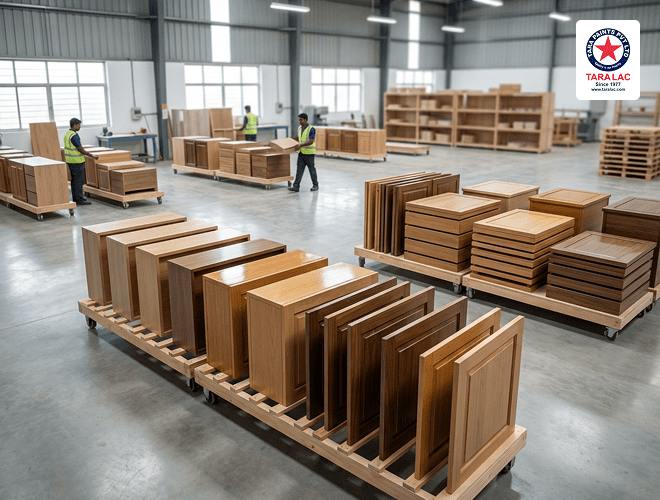
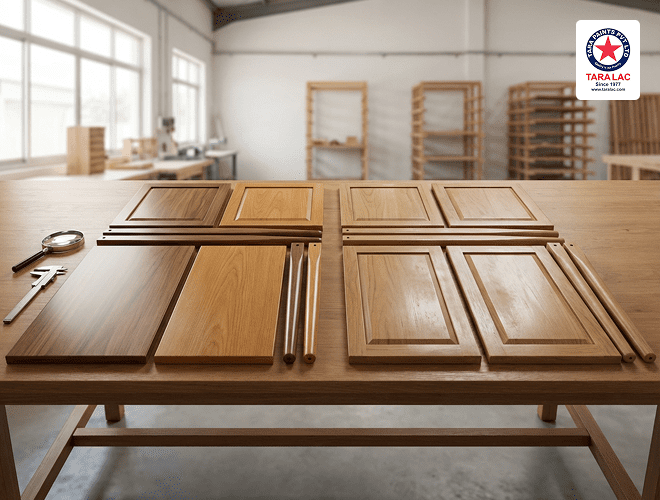
For carpenters, modular furniture units, kitchen manufacturers, and other woodworking setups, NC coatings offer clear grain visibility, quick drying, and user-friendly application. NC Paint for Wood allows smooth sanding, polishing, and film correction without extended waiting times between coats. It enhances grain visibility, protects the substrate, and gives furniture makers the freedom to adjust gloss levels according to design requirements.
The balanced film structure suits interior wood applications, cabinetry, shutters, display units, musical instruments, and decorative articles. This is also where the advantages of NC paint become highly relevant: predictable finishing behaviour, ease of repair, and dependable compatibility with sanding sealers.
Steps to apply NC paint on wood:
Sand the wood surface with progressively finer abrasives.
Apply a compatible NC sanding sealer and allow it to dry.
Sand lightly to remove raised fibres.
Spray the first coat of NC finish with controlled pressure.
Allow solvent to flash off before applying subsequent coats.
For premium gloss, complete with polishing or buffing once the film sets.
Tara Paints works with furniture makers, OEMs, and distributors who depend on wood coating manufacturers that can deliver consistent finish quality and reliable batch performance.
Ready to Transform Your Surfaces with Quality PU Paints?
Contact Tara Paints for premium polyurethane coatings that combine durability with aesthetic appeal. Our technical team is ready to assist you with product selection and application guidance.
NC Paint for Metal: Smooth Finish & Rust Protection
Industrial fabricators often prefer NC coatings for equipment casings, fixtures, metal furniture, automotive interiors, and consumer goods. NC paint for metal gives a clean, even finish and fits well into fast-paced assembly lines. While it is not intended to replace heavy anticorrosive systems, they provide sufficient protection for indoor metal parts and items that are serviced or refinished at regular intervals.
Steps to apply NC paint on metal:
Degrease and clean the metal surface thoroughly.
Apply a suitable metal primer to reinforce adhesion.
Lightly sand the primed surface to smooth it.
Spray the NC topcoat using controlled air pressure.
Add coats gradually to avoid sagging.
Allow adequate drying between coats and final handling.
Pros and Cons of NC Paint
Benefits
- Extremely fast drying, suited for rapid production
- Smooth finish that can be polished for a higher sheen
- Straightforward re-coating and routine maintenance
- A practical choice for furniture, paneling, and a wide range of metal items
- Clear film formation that brings out the wood grains
Limitations
- Not suited for environments with prolonged outdoor exposure
- Offers moderate chemical resistance compared with higher-end resin systems
- Needs well-ventilated application areas because of the solvent content
How to Choose the Right NC Paint Manufacturer?
When evaluating NC coatings for procurement, decision-makers usually look at several practical factors, including:
- Proven manufacturing experience supported by adequate plant capacity
- A QC setup with application-testing facilities and a solid certification record
- A product range that covers wood, metal, packaging, and broader industrial requirements
- Consistent supply across regions without disruption
- Technical guidance for OEM specifications, customised shades, or performance-driven variants
Tara Paints' long operational history and automated production infrastructure position the company as a dependable NC paint manufacturer with a strong base in western India. For procurement teams located in or around the firm also stands out as a capable NC paint manufacturer in Ahmedabad.
NC Paint vs PU Paint – What’s the Difference?
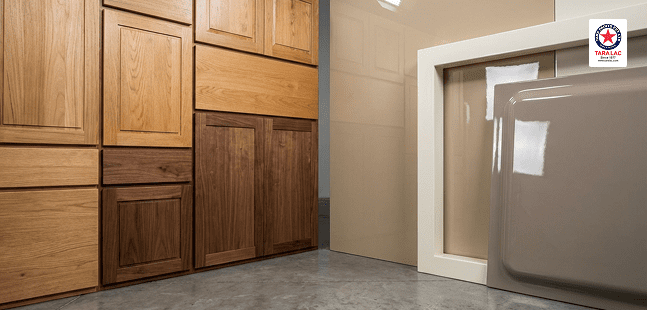
Buyers comparing resin technologies often evaluate NC and PU formulations side by side. NC coatings provide speed, clarity, and ease of repair. PU coatings offer greater hardness, chemical resistance, and long-term durability.
NC is often used in furniture workshops that require fast turnaround, while PU is used on surfaces exposed to moisture, heat, or extended use. The choice is guided by the required finish, expected service conditions, and the production pace a workshop needs to maintain.
Why NC Paints Are Ideal for Your Next Project
NC coatings are selected for their quick drying, steady film behaviour, and ease of use across wood, metal, and general industrial work. Manufacturers seeking higher volumes appreciate the predictable finish and uncomplicated application. A reliable NC paint manufacturer helps maintain uniformity across batches and supports production when output increases.
Tara Paints also serves broader industry categories, making it a suitable partner for specifiers seeking collaborations with wood coating and packaging coating manufacturers as part of a consolidated sourcing approach. With strong technical capabilities and certifications, the company supports a wide portfolio beyond NC, including primers, topcoats, and specialised industrial formulations.
FAQ’s
NC vs PU Paint?
NC offers rapid drying and easier repairs. PU offers greater durability and stronger resistance to heat, water, and chemicals. NC suits fast production cycles; PU suits premium or long-wear applications.
Is NC paint used with a hardener?
Most NC coatings do not require a hardener, though certain modified variants may include additives for enhanced film properties.
What are the ingredients in NC paint?
Typical components include nitrocellulose, plasticisers, resins, solvents, and additives controlling gloss, flow, and clarity.
What is NC paint?
A fast-drying nitrocellulose-based coating known for smooth film formation and quick re-coating cycles.
How long does NC paint take to fully cure?
Surface dryness occurs rapidly, often within minutes. Full cure depends on coat thickness and ventilation, but usually completes within a few hours.
Can NC paint be used on outdoor surfaces?
NC is best suited for interiors. Prolonged outdoor exposure may reduce gloss and durability.
What is the ideal temperature for applying NC paint?
Moderate room temperatures with controlled airflow are preferred to maintain uniform solvent evaporation.
Are NC paints environmentally safe compared to other coatings?
NC paints contain solvents and need to be applied in well-ventilated areas with routine safety controls in place. Current formulations are developed to keep emissions in check while maintaining the film quality and application behaviour expected from nitrocellulose systems.
How many coats of NC paint are recommended for best results?
Two to four coats are typical, depending on the desired finish and substrate preparation.

